Posts

Yolanda Soryl phonics training

Image
 Some take outs from phonics training with Yolanda Soryl. This was an excellent course, packed with information and all you need to get started teaching a quality, effective phonics programme. -data showing students' accelerated development of phonemic awareness skills as a result of being taught phonics in first year of school - especially for boys, ELL students, Māori, Pasifika, students from lower socio economic backgrounds and people with learning and literacy difficulties. (p7 of manual). -students need an 'integrated literacy programme' that includes handwriting, spelling and oral language. And it is important hearing our students read aloud (including older students) -'teachers who taught sounding out and blending explicitly accelerated reading attainment' (p10). I noticed doing recent GKR phonemic awareness tests that none of the group of 5.6 y students I'm working with could tell me f-u-n was fun. They are not able to blend and this is a skill required ...

Robyn Papworth - how to support children who are finding reading stressful

Image
Play Move Improve -  Notes from webinar: Before learning to read we need to build the foundation for reading. visual tracking - mirror tracking starts from birth. ie when holding baby - visual tracking together, eye contact. This is how early visual tracking begins. Children watch faces, watch things drop, throw things. Try hiding things - encourage eyes/tracking to work harder - hide key feature required ie find the pencil. Saccades - jumping eyes from point to point. Persuit - smooth from start to finish egwatching car move across infront of us Fixation - eg stop a numberplate of car, ball - stick things on ball - watch ball then watch stop and fix on stop point. Classroom entry video available - 5 movements on video that can run children through after break. Nurses torch, some interesting point to focus on. Look left, look right, look up, look down. chin should be still. Lately Robyn has seen much whole head movement and increase of number of children finding this difficult. S...

Maths - creating opeNups

Image
'OpeNups' are tasks that give students opportunity to activate their learning. A rich and balanced maths programme includes  tasks  - these are open and solved in a short time,  investigations  - solved over a longer period of time, and  games  - open, repeated use, focus can change. Open tasks promote the 'dos' (understand - know - do) - modelling and investigating and communication. The give us an opportunity to assess in a fun way - by children exploring.  We spent time building tasks that teachers can do repeatedly with students and adapt. The aim is to have a folder that cluster teachers will contribute to and share tasks for multiple levels. Teachers creating tasks builds consistency and alignment with the progressions. We'll have a folder of annotated 'samples' of what students need to be doing to be 'here'. I liked seeing how Rob modelled launching an investigation (into coordinates), how engaged all learners were and the possibility for te...

2022 Manaiakalani wānanga

Image
 Firstly - much kudos and respect to Alida Maritz and the other  Manaiakalani Innovative Teachers  for their sharing today. It was awesome to see Alida up on stage sharing her project, S urvival Kete for New Teachers , at the Manaiakalani 2022 wānanga today. She has created a valuable tool for teachers - especially those who are beginning teaching in NZ. The inquiry projects were a highlight of the day. Alongside the teachers' Survival Kete, a couple of sites that would be really useful for our school are  Read Between the Lines  for comprehension activities for our learners and  Algebros is a tool for maths learning - also a really good looking site.  Some other take outs and things to think more about from today: as leaders we need to check implementation, check theory and check ourselves and our confirmation biases.  Implementation journey of a self organised solution...  where light blue is how we got there from the data, what 's u...

Maths with Rob - Open Ended Task Design - part 1

Image
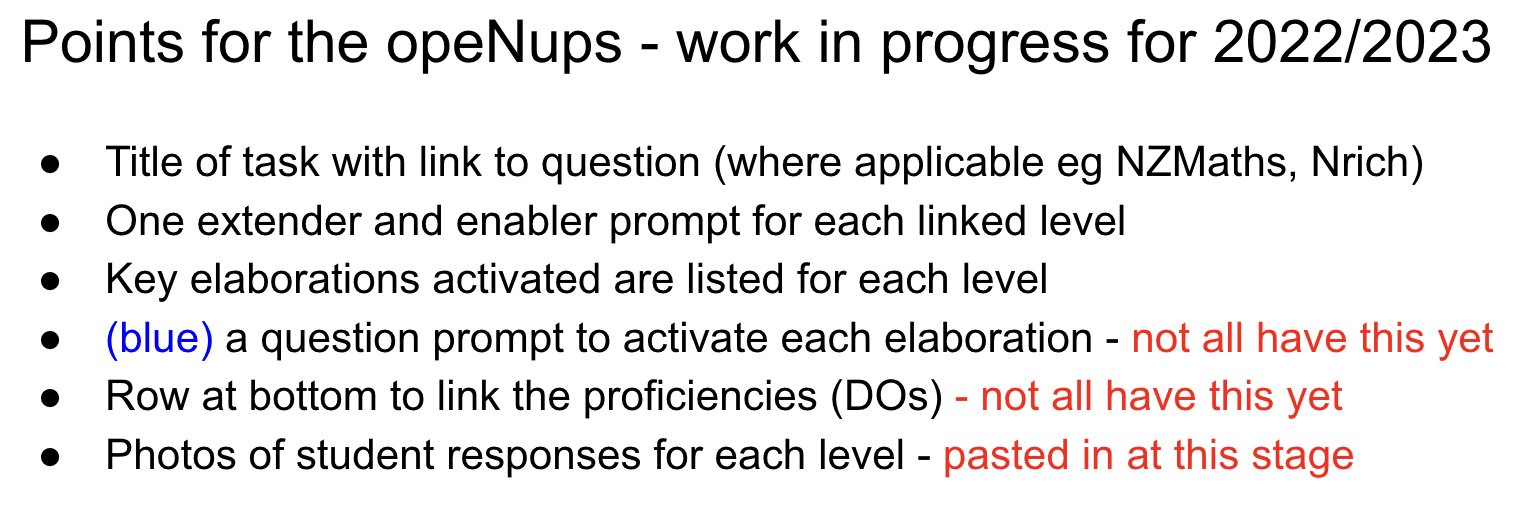
Another great session with Rob today.  I like that this was 'PLD for affirmation'. It showed how we can strengthen things we are already doing - not necessarily more stuff we need to do.  As an example, we thought of a game used in a junior maths class. We then looked through Rob's  Level 1 elaborations  and highlighted which elaborations were being 'activated' when the students played the game.   I thought of a game I saw some children in Karaka playing where they rolled a dice and covered up that amount of numbers on a hundreds board with counters. This is activating forward number sequences and visual patterns for numbers. Rob challenged us to think how we could tweak the game to hit more of the elaborations - e.g. use two dice, record the number they roll, do it backwards (ie cover the numbers first and remove them - so backwards sequencing). This emphasised the value of games in our maths programmes and how much learning they offer. We can use a game t...

Just-In-Time maths w Rob

Image
Our maths curriculum action team had the opportunity to observe some of Rob's demo lessons at Ardmore School last week. Rob modelled with a year 5/6 group how you can have 6 questions around the room, kids buddy up and move around answering as many as poss. Teachers rove listening in to chat. After 20ish mins of problem solving, students were able to select to go back to one of the problems and talk more about it with one of the teachers i.e. what was hard, what was easy, common strategies. This is an engaging and efficient way for a teacher to check in and see where kids are at and tune in to what misconceptions there may be and what next learning steps are. A way more efficient and engaging way to assess than GLoSS. We've planned to do this in Totara next week - it'll be great formative assessment. MoveNprove - this is a way to deliver a multi-choice question. It provides teachers with a quick snapshot of children's thinking in maths.  In a MoveNprove is a great '...

Toolkit: Your Daily Drive, hosted by Fiona Grant

Image
Fiona's slides Daily was the key here - Fiona's message is that students need to practise using their Drive everyday. This needs to be routine and is part of being a 'Cyber Smart Learner'.  For example - can you find your Drive quickly. There are three quick ways to find your Drive - it's good to know these. Some people like bookmarks, some like short cuts... We need to be planning and designing opportunities each day for students to work with Drive  - this doc is for teachers - we can check there are opportunities for children to do at least one activity similar to these each day. So for example, at writing time teachers might use the 'Weekly Writing Doc' for students daily journalling. These 'cyber smart' learning and practise activities would be a part of the learning already happening, rather than 'another thing', or something done as well as. There's lesson plans for teachers. It would be good to include something like these  Daily ...

Creative Schools: A Blaze of Colour - conference 01.02.22

Image
 Te Rito Toi is a fabulous resource I have posted about previously that shows us the value in using the arts to re-engage children in learning following disasters and crisis (i.e. EQs, COVID). This conference was an opportunity to explore some of these lessons and have workshops with wonderful art practitioners. Professor Peter O'Conner  began today by sharing ' Teaspoon of Light ' -  It is an ideal lesson for first days back and may be extended upon.  Peter took us through the lesson with us as his students, which allowed us to experience how powerful every element is and that schools must prioritise  time and space for art and to connect, create and be together.  A warm up and connection activity (a drama game where we moved around space and greeted others in variety of ways) immediately made the space seem more comfortable and friendly/safe. Contributing to a cloth of dreams - chatting to others or not.   Peter talked about the power of questions, e...

Te Rito Toi - Returning to school through love and care

Image
  This webinar had important messages for schools that will guide us as we welcome students back. All teachers at our school have watched the webinar. We want to ensure we welcome our children back by going gently. We have permission to, and it is important that we work differently.  Professor Carol Mutch who researches the role of school in disaster and crisis settings (such as Canterbury earthquakes, the Christchurch terror attack and covid pandemic) was a on the panel as well as Professor Peter O'Connor who is one of the leads of Te Rito Toi. It was interesting to think about the fact that some families will have 'cascading trauma' - event after event (Lynn Mall Attack, West Auckland floods..) Children will return to school with different 'baggage' and need to reengage gently. We can't assume but must show awhi, aroha and inclusivity.  It's important schools acknowledge there's a lot we're trying to do and to take support offered.  From Carol...

Toolkit - Minecraft: Education Edition

 Thanks to Louise from Papakura Central who hosted this. It was good to have breakout rooms, polls and jam boards used in this toolkit too. Slides (There is another toolkit also available that Louise has done on Minecraft - Education Edition (M:EE).) We were encouraged to take some time to just get in there and have a play, cos apparently it's fun and you can't break it.  Keep in mind when using with our students, we'll be teaching to the experts - so they will be doing much teaching, talking, sharing etc. Minecraft is a great fit with learn, create, share. From the Minecraft EE site  you can join communities and the Minecraft Teacher Academy which offers training and badges! You can work towards becoming a Minecraft Certified Teacher. Louise recommends having a mouse as it is harder with a track pad apparently. This jamboard  from the toolkit shows learning topics/contexts and possible Minecraft tasks that could support learning. There are also pre 'built'?? lesson...

Toolkit - The Hikairo Schema

Image
 This toolkit was hosted by Erin Connolly who teaches in Greymouth. Erin shared how she uses what she has learned about the Hikairo Schema . Her school has had impactful professional learning with authors Angus and Sonja McFarlane and she has used this resource to guide her own professional learning. Erin uses he poutama - a cultural competency framework - to track and scaffold her practice. She says it is clear and easy to follow. This gives Erin a structured approach to improve cultural compentency. She shared how she looks at these with a colleague and reflects on next steps. Erin also shares her own learning goals with her students. Her current focus is huataki (see image below) and Erin talked about how she starts her lessons and includes pepeha and music to connect with her students and also ensures her online learning easy to follow and is reflective of 'us and where we are'. I thought that was an important comment prompting teachers to consider our students' learnin...

notes from Manaiakalani wānanga - Woolf Fisher Research Summary

Image
 Rebecca Jesson ( slides ) is asking us to consider what has the greatest likelihood to work for our students. What is likely to work for a child and what is working for that child? Look closely and interrogate our practice. Refine and review.  executive function / inhibitory control - how children manage and regulate themselves. Important in reading.  making sure what you are doing is going to be successful for you. Reading with intent: 1. Purpose, 2. Learning Intentions, 3. Strategies. If we don't have purpose for reading - will we care? (affective?) Learning intention telling children what to notice. Strategy that you think is important. We think with language. background knowledge important underpinning of what we're reading. Avoid 'hodge-podge' vague collection and use connected text, layers, builds from one to another. Building unified theme.  Knowledge of learners to influence text selection 'mirrors, windows and glass sliding doors'. Opportunities to be...

transitioning back to school -

Image
Notes from Cognition Events wellbeing webinar - Transitioning Back to School: Dwell in Possibility presented by Rebecca Thomas and Steve Saville. What is the best environment for the students to come back to? Key message is the need to create a calm environment . Students and families might be anxious about what they've missed out on. It would be a mistake to think we need to 'catch them up'.  Teacher credibility is key ( research paper here ), as is the importance of routine, clarity of message and competent and trustworthy adults. Actively teach tolerance (this was brought up in context of high school setting - it was recorded by presenter prior to mask wearing in high schools being mandated, how will teacher manage transition back in terms of mask wearing and potential conflict) Tips: disconnect from devices for part of day - teachers and students. Engage in conversation, genuine connection, responsive interactions with others. caring for things - class pet, plant etc. ...

Just in Time Maths (with Rob)

Image
 Last week I attended a couple more sessions of maths PLD with Rob. The first was an 'open invite' zoom hui session - he's run a series of these. This one was looking at engagement and diversity . 1. using ARB s (Assessment Resource Banks). Rob's first guest was Jonathan Fisher from NZCER. He explained that ARBs support evidence-based teaching and learning practices. They are targeted assessment tasks and many suggest ideas for next teaching steps. For more info you can go ' about the arbs '. Arbs are flexible assessment tools - e.g we might use some of the multi-choice questions for a diagnostic move'n'prove activity, use them for small group explicit instruction or use for consolidating learning. Many can be done online or  on paper. They support teachers build pedagogical and content knowledge. Also - the researchers working on these tools really appreciate any feedback. A next step for me is to explore the  conceptual maps  within the arbs platform w...